
SDG 10 Reduced Inequalities
Ranked 25th in the World
Find out more about the THE Impact Rankings
We actively participate in, coordinate and lead a range of initiatives and activities that align to the United Nations' Sustainable Development Goal (SDG) 10 Reduced Inequalities.
Accessible Campus and Facilities
Campus and Access Maps
Downloadable PDF and online maps are available for staff, students, and visitors.
Accessible Parking
Free parking is available at our regional campuses. Disabled parking spaces are allocated and available for use by anyone displaying a valid disability parking permit and can be located on our campus maps.
Access on campus
Our regional campuses feature concrete pathways to all major buildings. Learning and teaching spaces feature ramps or lifts to ensure accessibility to all students and details can be located on our campus maps.
Amenities
Accessible amenities are available across campuses and clearly signed for ease of locating. Further details of locations of amenities can be found on campus maps.
Parent and Feeding Room
Located on the ground floor of Building 36 within the Commercial precinct of the Rockhampton North campus, an airconditioned room is dedicated to supporting the needs of parents and breastfeeding mothers. The room features comfortable seating, a selection of children's toys and books, and a microwave for heating milk or formula.
Pedestrian Zones
The external spaces in our regional campuses are fully pedestrianised with no vehicle access (except for service vehicles).
Web Accessibility
CQUniversity is committed to ensuring our online material and content is accessible to all. If staff or students are experiencing difficulty accessing any online materials produced by the University, they are encouraged to contact [email protected] and provide details of the issue. The University will then make arrangements to provide the information in an accessible format.
Support for Underrepresented Groups
We are proud to have the highest ratio of students from low socio-economic, mature age, Aboriginal and Torres Strait Islander, and first-in-family backgrounds. The University defines itself by who it embraces rather than who it excludes, and because of this is widely recognised as Australia's most inclusive university. We are focused on creating and build stronger relationships and sustainable opportunities that will enable equality and integration, greater study, employment and research prospects and the reciprocation of knowledge.
Our Indigenous Engagement Division (IED) plays a pivotal role at the University in providing leadership to improve higher education outcomes for Indigenous Australians. The office drives informed policy development to influence the way in which the University provides higher education, training, research opportunities and engagement that expresses a deliberate destiny for Aboriginal and Torres Strait Islander people.
The Indigenous Student Advising Specialists within the Student Service SPOT provides advice about a number of support services available to Aboriginal and/or Torres Strait Islander students including:
- Free tutoring support
- Financial Guidance
- Cultural Advocacy
- Safe learning support
- Basic course information, and more.
Student Support Services are available for all students including those from underrepresented groups such as Aboriginal and/or Torres Strait Island students, international students, and students with disabilities.
Services include:
- Welfare Support
- Career Support
- Academic Support
- Campus Support
We have dedicated employees available to assist with any equity or diversity requirement including our Equity Program Officers and Student Access and Equity Manager. To reach out to the Program Officers, contact the Equity and Diversity Office.
We developed an online micro-credential which explores what it means to work in a diverse workplace and introduces the roles of leadership, valuing individual and group differences and promoting a culturally diverse and harmonious workplace.
Our Student Mentors are existing students who volunteer their time to help new and continuing students transition to life and study at university.
We are dedicated to creating a safe and supportive atmosphere for all students with a zero-tolerance approach to bullying and discrimination. As part of this, we have implemented an Ally Program to promote acceptance and understanding for lesbian, gay, bisexual, transgender, intersex, and queer (LGBTIQ) students.
There is an Ally Network on Moodle as a connection point for any student who would like to be involved, with resources, links, and forums. It is a place for students to access support and get in contact with an Ally.
Scholarships
There are a number of scholarships available for students with disabilities and/or students from underrepresented groups. For more information on available scholarships, visit our scholarships page which includes both our University and external stakeholder scholarships.
Outreach Programs
We deliver educational outreach programs and activities such as lectures, demonstrations, presentations and displays. Many of these activities are driven by our staff, and as a student, you may be involved in voluntary student-run initiatives during your time with us.
Explore the sample of the outreach activities undertaken in 2025 below:
General
- Widening Participation Strategy – we have a widening participation strategy that aims to promote higher education to low socioeconomic, regional and remote, and indigenous school students and sees our Connect team partnering with schools to deliver programs outreach programs.
- CQU Connect engages with school partners to deliver outreach for Year 6 to Year 12 students via independent learning modules, classroom activities and on campus events. We work to raise aspirations towards tertiary education and ensure students from regional, remote, low socio-economic and First Nation communities develop confidence by feeling connect to tertiary education. Via this program we work in partnership with other institutions and focus on encouraging students towards any tertiary education options they desire although we of course hope to see them graduate from CQUniversity one day.
- Principal's Recommendation Scheme - Our Principal’s Recommendation Scheme is an early offer scheme that allows Year 12 students to apply to an undergraduate CQUniversity course based on the recommendation of their high school Principal rather than ATAR.
STEM
- CQ Junior Robotics Competition – Registration is open to students from Years 4 to 12 in Central Queensland, provides an engaging environment for young minds to develop skills in problem-solving, creativity, critical thinking, and teamwork. Hosted annually by CQUniversity since 2002, the event offers various categories, including soccer, dance, and rescue, allowing participants to explore robotics in ways that align with their interests. This educational initiative highlights the fun and excitement of science, engineering, and technology through a hands-on, multidisciplinary approach. Students work on designing and programming robots to tackle real-world challenges, learning to adapt to complex and changing environments. The competition promotes collaboration and encourages students to broaden their knowledge across disciplines such as computing, mathematics, and artificial intelligence. Participants come from across the Central Queensland region to Rockhampton, and many go on to succeed at state and national levels. Academic staff and robotics enthusiasts offer guidance, ensuring a safe and supportive environment for the students. The event not only inspires a love for science and technology but also fosters community engagement and introduces students to the exciting possibilities within these fields.
- Connecting STEM with Music- The annual event combines the two disciplines in an interactive and educational way through a series of hands-on workshops and activities designed to enhance Year 4 & 5 students musical understanding.
Presented in conjunction with the Queensland Symphony Orchestra and CQUniversity's STEM Central, the annual full-day workshop has run for several years. - Careers in STEM workshop- A group of First Nations high school students are now considering a job in STEM after completing a careers program at CQUniversity.
- Stability, Strategy & STEM Innovation: 2026 and Beyond, celebrated seven years of achievements and launched the new STEM Central Collaborative initiative to ensure stability and long-term impact through innovative science, technology, engineering, maths (STEM) education.
- Rockhampton Science and Engineering Challenge- Nearly 200 Central Queensland high schoolers dove deep into the inner workings of engineering alongside CQUniversity students at the Rockhampton Science and Engineering Challenge recently.
Arts
- Choices Program – A theatre project that promotes key safety messages and education around alcohol, drugs and sexual activity for young people, by young people, using a music theatre format of comic skits, songs and dance. The Choices project tours secondary schools throughout central and north Queensland every year in preparation for Schoolies.
- Safety Circus – Operating since 2013, the Safety Circus project is an award-winning project of the CQCM in partnership with the Mackay Crime Prevention Unit of the Queensland Police Service and the Daniel Morecombe Foundation. It is a 50-minute music theatre show aimed at Year 2 students to teach them about personal safety, safety on non-motorised transport and dealing with bullying. Written by Hannah Barn with music by Professor Judith Brown AM, The Safety Circus is performed by students from the Bachelor of Theatre degree and directed by CQCM theatre alumni. It tours to primary schools throughout the Mackay, Isaac and Whitsunday regions of Queensland each year.
- CQ Conservatorium of Music Summer Performance – The CQCM's Summer Spectacular is a week-long intensive theatre program designed for high school students aged 12 to 18. Participants have the chance to enhance their musical theatre skills under the guidance of a professional music theatre director and award-winning staff from the Central Queensland Conservatorium of Music (CQCM). The program culminates in a public performance, the Summer Spectacular concert, where students showcase their talents. Admission to the concert is free for the public.
- CQ Schools Jazz Festival- The festival is a unique event in Central Queensland that provides students with performance and development opportunities in jazz. Since 2012, participants have benefited from masterclasses, clinics, and adjudicated performances led by world-class musicians and educators. These sessions help young musicians grow their skills in an encouraging and educational environment. Past clinicians have included renowned artists such as James Morrison, Jeff Jarvis, and Greg Spence. The festival celebrates the region's talented students and is a valuable opportunity for jazz education in regional Queensland.
- Conservatorium Academy- The Conservatorium Academy is a centre for creative and performing arts training for school-age children in Central Queensland. The aim of this program is to provide music and theatre training as an extension to the dance, drama and music classes that young people may already be engaged in.
- Blending theatre, song and storytelling, performed by CQU Bachelor of Theatre students, the Safety Circus delivers important lessons about road safety, personal safety and bullying prevention in a fun and memorable way.
Agriculture
- RACE - Gippsland will deliver a range of hands-on, interactive, and engaging activities to primary and secondary students focused on raising aspirations in agriculture and building student capacity in STEM, digital technologies, agribusiness, manufacturing and food and fibre concepts.
- RACE- Goulburn brings local Agriculture to the classroom, inspiring students to build their capacity in STEM, digital technologies, agribusiness, manufacturing, food, and fibre
- Project Booyah – we are a training partner in Project Booyah which provides educational opportunities for at-risk young people. It is a partnership between the University and the Queensland Police Force.
- Smith Family Learning for Life program – we partner with The Smith Family to deliver the Learning for Life Program. The Smith Family is a charity that supports financially disadvantaged young people with assistance in maintaining their educational aspirations. The University is working with Rockhampton and Mackay Learning for Life staff to open up pathways to higher education for scholarship families, through information sessions and by supplying families with university program and scholarship information.
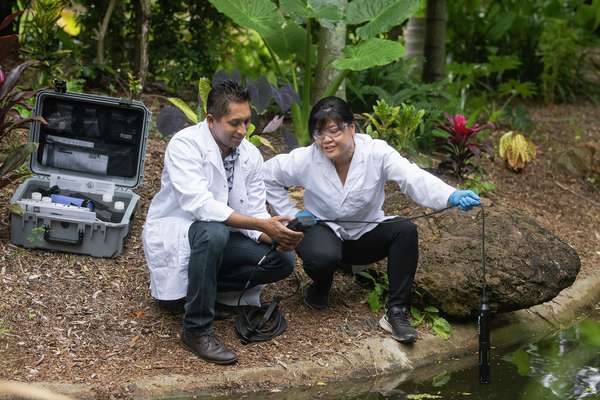
- Seagrass: Citizen Scientist Program – This initiative engages volunteer community members to collect seagrass flowers in Gladstone Harbour, for the final harvest of the season. This is part of the Sea Flowers: Growing Community Engagement for Seagrass Restoration Project and teaches volunteers how to work together to ensure the restoration of the vital flora.
- WinTECH Society – The Women in Technology (WinTECH) Society has developed free online workshops teaching students skills in data science using Excel and Python software. The workshops encourage students to choose STEM career paths.
- Gladstone’s STEM Central – It’s a state-of-the-art experience that takes science, technology, engineering and mathematics out of the classroom and into the real world, one of the highlights of STEM Central has been the diversity of people who use of the facility – from five-year-old children getting their first experience of flying a drone, primary and high school groups from right across the region, then Indigenous elders, and even senior citizens.
- Student Health Clinics – Our Student Health Clinics operate in Rockhampton, Mackay, Sydney, and Brisbane. These clinics are a collaboration between health care practitioners and our students to deliver local health services in oral health, speech pathology, physiotherapy, podiatry, and chiropractic services.
- Australian Defence Force Reservists – Several CQUniversity employees are active in the ADF Reserves and are often deployed to operations in response to various natural disasters that impact on all Australians including bushfires and catastrophic flooding. Our commitment to supporting staff to engage in such activity led to it being announced as the 2020 Defence Reserve Employer Support Award winner under the not-for-profit organisation category.
Studying abroad for a year, term, or even just a couple of weeks is a very rewarding and educational experience. Students have opportunities to travel, make friends from around the world, enhance employment prospects, and even learn another language. Above all, they will gain a fresh perspective on the world around them. We are all part of an increasingly globalised world and international study gives students a cultural awareness and life experience that will set them apart from their peers. Read more about these experiences from 2025 and 2026:
- African opportunity strengthened psychology graduate for regional career
- Allied health students work hand-in-hand with Fiji school
- Students create change with pencils and playgrounds
- From Townsville to Mongolia: CQU student broadens horizons
- Study tour beefs up student knowledge
- Engineering students aim to protect India’s sacred groves
- Wildlife Law and Protection in Vietnam- The tour partners with Education for Nature Vietnam and Vietnam National University School of Law and allows CQUniversity law students to understand first-hand the legal, cultural and environmental context of wildlife protection and illegal trafficking.
- Salaam Baalak Trust, India - CQUniversity is a partner with the Salaam Baalak Trust and supports its WALK project. CQUniversity health students visit Salaam Baalak and participate in local health projects.
You can find out more on our CQUGlobal Outbound page.
News Stories
Some of the recent news stories that align with SDG10 Reduced Inequalities:
- Asking questions so new parents with disabilities get better answers
- State of STEM inspires future innovators during NAIDOC Week in Gladstone
- Opening doors and changing lives: Karen Seary’s 32-year legacy
- Destination Doctor program inspires next generation of regional medical students
- Help hits new heights for Fitzroy Community Hospice
- New tool to tackle old problems for horse welfare
Projects
Bundaberg, QLD residents living with a disability will be able to access local beaches and enhance their lives through movement thanks to the Universal Beach Access Hub (U-Beach). U-Beach is a project driven by our university, in collaboration with Bundaberg Regional Council, Surf Lifesaving Queensland, Community Lifestyle Support, and Rotary Bundaberg Region, as well as local education providers and sporting clubs.
Led by Lecturer in Neurological Physiotherapy Dr Vanesa Bochkezanian, the Electrical Stimulation (E-Stim) treatment aims to increase muscle mass, reduce spasticity and improve overall physical health. The project uses electrical stimulation to improve the lives of those living with spinal cord injuries.
Our vision for reconciliation remains a more just and equitable Australia achieved through the self-determination of Aboriginal and Torres Strait Islander peoples, supported by a tertiary education sector that truly embraces their knowledges, leadership and strengths.
We continue to work towards achieving this vision of reconciliation – by not only incorporating and normalising Aboriginal and Torres Strait Islander cultures and perspectives within our everyday business, but also by promoting First Nations voices and contributions across our partners and stakeholders, and our wider communities. The Stretch Reconciliation Action Plan is an important step in meeting our vision.
Commitment to Sustainable Development Goals (SDGs)
We are proud to be Australia’s most engaged university and to support the development of global sustainability.
Student Activities
Explore where our students have been volunteering and contributing to projects.

Our Policies and the SDGs
University policies that govern and guide our commitment.