Bachelor of Oral Health

Overview
CQUniversity’s Bachelor of Oral Health equips you with the skills and knowledge to perform preventive and operative dentistry for patients across the lifespan.
Oral Health Therapy is an evidence-based health profession. In this course, you will learn to perform preventive and restorative dentistry for patients of all ages, gaining the skills to effectively synthesise assessment findings, formulate management plans, deliver appropriate clinical treatment and evaluate patient-centred outcomes. You will also be able to provide supportive orthodontic services, dental therapy and hygiene services, non-surgical periodontal treatment, oral disease prevention and health promotion. In addition, your education and training will provide you with underpinning industry knowledge so you can educate and promote oral health in small group and community settings.
During this course, you will learn how to apply critical thinking, clinical reasoning and reflective practice to be able to provide clinical services that extend from restorative care for patients of all ages.
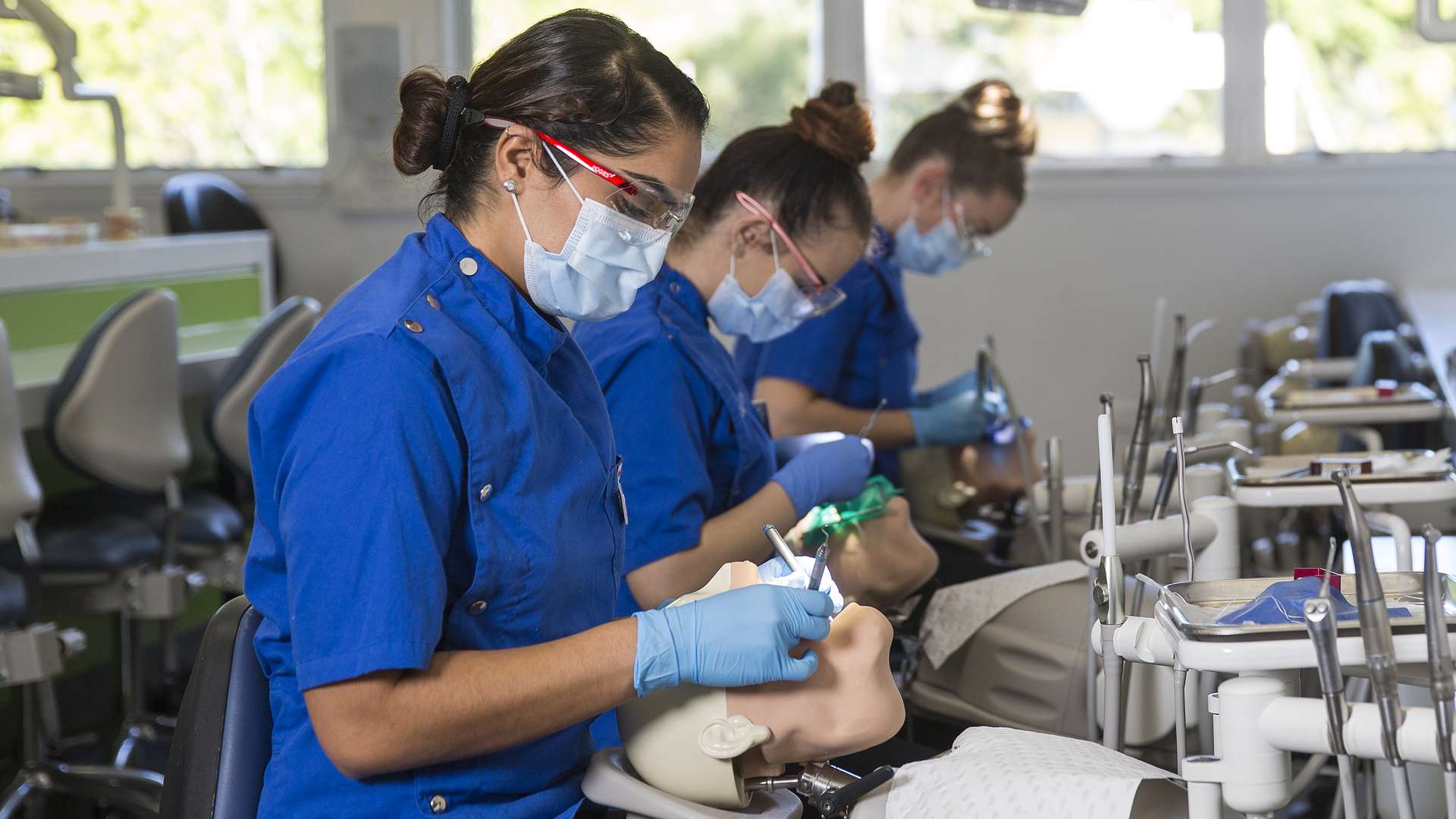
This course has a strong focus on work-integrated learning in pre-clinical and clinical settings such as our purpose-fit oral health laboratory and dental clinic at CQUniversity Rockhampton. This allows you to gain valuable practical experience whilst also increasing your employability. During your studies, you will benefit from learning alongside students in other health courses in facilities such as CQUniversity's Health Clinic.
Study Experience
Discover more about your industry-accredited oral health degree and how you'll benefit from practical experiences in real-world settings. Click 'Explore Study Experience' for more information.
- Authentic Learning Experiences
- Clinical Placements
- Industry Accredited
- Real-world Learning Facilities
“CQU has so many facilities, like the oral health clinic and you can actually see real patients instead of just working on each other.
Loran Ware
STEPS, Bachelor of Oral Health
Career Opportunities
Upon completion of the Bachelor of Oral Health, you will be eligible to apply to the Dental Board of Australia for registration as a 'Dental Practitioner - Oral Health Therapist'. You will be able to perform preventive and operative dentistry for patients across the lifespan and be well equipped to educate and promote oral health in small group and community settings. Employment opportunities are available in private general and specialists’ dental practices and in community-based settings.
To apply for general registration as a dental practitioner, please visit the Dental Board of Australia website.
Structure & Availability
The course structure and available locations can change depending on when you want to study.
You can choose the intake that best suits you in the drop-down menu below. Visit the Academic Calendars webpage for key dates relevant to your chosen intake.
Available Locations
Your Course
You must complete 20 units (144 credits):
- 1The core structure (20 units)
Unit Details
The units you'll study are listed below. Click on a unit to learn more.
Course Planner
To help you plan your studies and see which unit comes first, if one unit should be completed before another and the term you will study each unit, check out our course planners.
Additional Information
Professional Practice - Australian Dental Council (ADC)
Core
The Bachelor of Oral Health course at CQUniversity is accredited by the Australian Dental Council (ADC) and approved without conditions by the Dental Board of Australia (DBofA) until 31 December 2030. The course is accredited by the Australian Dental Council in accordance with s48 of the National Law.
Introduction to Oral Health Therapy - ORAL11001
Work-based learning takes place in the oral health simulation laboratory (up to 10 x 2-hour sessions per term) and oral health clinics on campus (up to 7 x 2-hour sessions per term).
Introduction to Oral Disease - ORAL11003
Work-based learning takes place in the oral health clinics on campus for up to 2 x 3-hour sessions per term.
Introduction to Oral Health Practice - ORAL11006
Work-based learning takes place in the oral health simulation laboratory for 2 x 3-hour sessions, per week, per term and the oral health clinic on campus for up to 10 hours per term.
Oral Health Pre Clinical Practice 1 - ORAL12002
Work-based learning takes place in the oral health simulation laboratory or oral health clinics on campus. Part A is for up to 2 x 3-hour sessions per week per term, part B is for up to 6 x 2-hour sessions per term. An additional 2 x 3-hour sessions are also scheduled during a teaching intensive prior to term commencing.
Oral Health Clinical Practice 1 - ORAL12003
Work-based learning takes place in the oral health clinics on campus for up to 2 x 3-hour sessions per week per term. An additional 7 x 3-hour sessions are also scheduled during a teaching intensive prior to term commencing.
Advanced Oral Health Practice - ORAL12004
Work-based learning takes place in the oral health prosthetics laboratory, oral health clinic and/or oral health simulation laboratory on campus over 6 days per term.
Paediatric Dentistry for the Oral Health Therapist - ORAL12005
Work-based learning takes place in the oral health simulation laboratory on campus for up to 17 x 3-hour sessions per term.
Oral Health Clinical Practice 2 - ORAL12006
Work-based learning takes place for up to 4 x 3-hour sessions per week per term at the oral health clinics on campus. Additionally, local external opportunities also occur. These may include practical placements at community centres, school dental clinics, residential care facilities and community engagement activities, as well as observational placements at general and specialist dental practices.
Oral Health Clinical Placement 1 - ORAL13001
Work-based learning takes place in a variety of settings 4-5 days per week per term. This includes general dental practices, specialist dental practices, school dental clinics, oral health clinics on campus and residential care facilities. These clinical placements may be undertaken across Queensland or in other states and territories across Australia. There is an additional two-week teaching intensive prior to term commencing.
Oral Health Clinical Placement 2 - ORAL13002
Work-based learning takes place in a variety of settings 4-5 days per week per term. This includes general dental practices, specialist dental practices, school dental clinics, oral health clinics on campus, residential care facilities, community centres and community engagement. These clinical placements may be undertaken across Queensland or in other states and territories across Australia.
You are required to undertake a minimum of 1000 hours of clinical placement. The Bachelor of Oral Health course involves extensive training in a clinical environment, initially using simulator technologies before progressing to full-time clinical placements in an oral health environment. Students should be prepared in their final year of study to spend four days per week in full-time clinical placements as part of the course requirements.
If you have prior experience or have studied previously, you may be eligible for credit or recognition of prior learning (RPL), which can help reduce your study load and the time it takes to complete your degree.
Learn more about credit and RPL, including application timelines and the overall process.
This course does not permit you to defer your offer and commence at a later date. If you are unable to commence in the term you receive an offer, you will be required to submit a new admission application or change your preference with the Tertiary Admission Centre to commence at a later date.
Requirements
To Be Eligible
For your application to be considered, you must meet the following entry requirements.
Student and Course Profiles
View the student and course profiles for this course and learn about CQU's Undergraduate Profile for Term 1, 2026 via our Institute Profile.
Alternative Entry Pathways
CQU offers a range of alternative entry pathways to help you get started. If you don’t meet the entry requirements, there are options available, depending on your background and previous experience.
During Your Study
While not needed to apply, you'll need to meet the following requirements throughout your studies.
Fees & Scholarships
Indicative First-Year Fee
The Indicative First-Year Fee is the approximate cost of enrolling in this course for one full-time academic year (eight units over two terms) for a Commonwealth Supported Place (CSP) and should be used as a guide only. Your actual fees may vary depending on the units you select to study and your study load. Check the Cost per Unit spreadsheet available on our Understanding Course Fees webpage.
Fees are reviewed each year and are subject to change. Fee estimates for the following year are expected to be available in September each year.
Commonwealth Supported Places
This course has Commonwealth Supported Places (CSPs) available, and as a domestic student, you'll be offered a CSP, provided you meet CSP eligibility requirements. CSPs are subsidised by the Australian Government, meaning you are only required to pay the student contribution rather than full tuition fees.
Important
If you are a new student and are offered a CSP, you must submit an eCAF (electronic Commonwealth Assistance Form) with the Australian Government to confirm your place, even if you are ineligible for or don’t intend to use a HECS-HELP Loan.
This is a Government requirement, and if you don’t submit before your commencing census date, your enrolment for the term will be cancelled.
HECS-HELP Loan
You may be eligible for a HECS-HELP government loan if you are offered a CSP. HECS-HELP is an Australian Government loan scheme that assists you in paying your student contributions. Provided you meet the HECS-HELP eligibility criteria, you may use HECS-HELP to defer part or all of your student contribution fees.
Part of your course costs will include Student Services and Amenities Fees (SSAF). SSAF is charged in addition to your student contribution or tuition fees and is used to help enhance your study experience. There may also be other costs as part of your studies, such as textbooks, technology expenses, travel expenses, professional certifications, uniforms, or vaccinations.
We believe a quality education can be for everyone – regardless of background, location, or life circumstances. That's why we offer a variety of scholarships and bursaries that can give you a helping hand with a range of expenses and enhance your employability.
How to Apply
How to Apply
Select where you'd like to study and your preferred intake
You'll need to choose where you would like to study in the 'choose where you live' selector. This course is only available on campus, so not all states or territories will be listed.
Your Application Options
Follow These Steps
Extra Admission Information
Prior to applying, take a look at important application dates and learn about our admission considerations, such as information for domestic students with overseas qualifications, indigenous support, and elite athlete, coach and performer support. You should also check out the adjustment schemes that might be available to you and how to access them. You can also explore our offer information to learn more about what happens after you've submitted an application and how to respond to an offer to study with CQU.