
Bachelor of Education (Secondary)
Overview
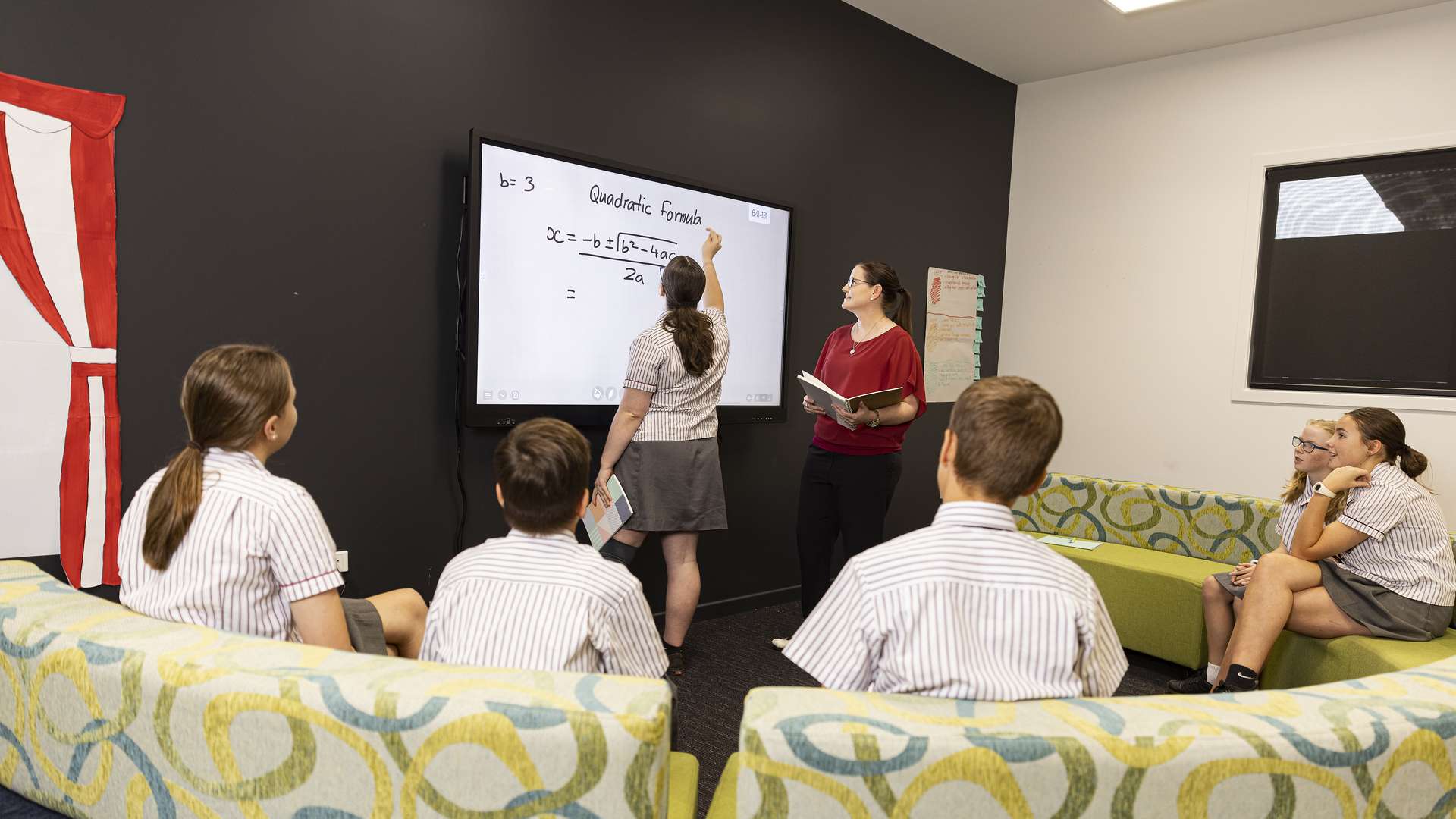
Make a difference in a young person's life and guide them to reach their full potential. The Bachelor of Education (Secondary) will prepare you as a well-rounded graduate that qualifies for professional registration as a secondary school teacher within Australia.
Watch our Education Open Day Webinar on demand.
Embedded into the course is frequent and meaningful work experience and professional practice in authentic educational settings. Preparing you to graduate work-ready and confident in the classroom.
The course includes 85 days of planned teaching practice in secondary schools, plus other opportunities for you to apply theoretical knowledge in practical ways. You will also develop the skills to teach effectively in various contemporary educational settings.
During your studies, you will choose two teaching disciplines to focus on to meet the requirements of the modern classroom. A full list of the teaching discipline areas can be found below in the Majors and Minors section.
Trade Entry
If you hold a relevant trade qualification and want to become an Industrial Technology and Design or Home Economics teacher, you may be eligible to apply via our trade-entry pathway. The trade-entry pathway recognises prior learning (RPL) for your approved trade into the course and reduces the number of units you will need to complete. Graduates from the trade-entry pathway exit with one teaching area only, given they receive RPL into the course.
Study Experience
Discover more about your Bachelor of Education (Secondary) and how you'll benefit from flexible on-campus and online study options, plus 85 days of planned teaching practice in high schools. Click 'Explore Study Experience' for more information.
- Authentic Learning Experiences
- Fast-track Option
- Global Experiences
- Local Networks
- Online or On-campus
- Student Accommodation Options
Career Opportunities
On completion of a Bachelor of Education (Secondary), you will be qualified to teach two specialist areas within secondary schools to Year 12.
As a graduate of this course, you may also continue your studies with our range of postgraduate education course that are available for registered teachers.
Structure & Availability
The course structure and available locations can change depending on when you want to study.
You can choose the intake that best suits you in the drop-down menu below. Visit the Academic Calendars webpage for key dates relevant to your chosen intake.
Available Locations
Your Course
You must complete 31 units (192 credits):
- 1The core structure (19 units)
- 2Two six-unit minors
Unit Details
The units you'll study are listed below. Click on a unit to learn more.
Core Units
You will study the 19 units listed below.
Agricultural Science (Including Year 7-10 Science) Minor
The Agricultural Science (Including Year 7-10 Science) Minor consists of six units.
You must study:
- Livestock Production (AGRI11003)
- Agriculture Technology Transformation: The Future of Food and Fibre (AGRI13008).
You will a choose one elective:
- Soil and Irrigation Management (AGRI11001)
- Plant Science and Crop Production (AGRI11002)
- Plant and Livestock Breeding Strategies (AGRI11007).
You will also choose three electives:
- Animal Health and Welfare (AGRI12001)
- Driving Productivity in Food Production Systems (AGRI12013)
- Social Licence to Operate (AGRI13001)
- Professional Placement or Project (BIOL12050).
Professional Placement or Project (BIOL12050) is offered in both the Agricultural Science and Biology Minors. If you select both minors and study BIOL12050 in one minor, you cannot choose this unit in the other minor.
Course Planner
To help you plan your studies and see which unit comes first, if one unit should be completed before another and the term you will study each unit, check out our course planners.
Additional Information
Professional Practice - Queensland College of Teachers
Core
Graduates are eligible to apply for provisional registration as a teacher upon completion of the course.
Professional Practice 4 - Engaged Teaching and Learning - EDFE14021
Supervised and assessed in-school placement as per EDFE14021 Professional Practice 4 - Engaged Teaching and Learning Unit Profile
Professional Practice 3 (Secondary) - Engagement with Others - EDFE13033
Supervised and assessed in-school placement as per EDFE13033 Professional Practice 3 (Secondary) - Engagement with Others Unit Profile
Professional Practice 2 (Secondary) - Application of Curriculum - EDFE12043
Supervised and assessed in-school placement as per EDFE12043 Professional Practice 2 (Secondary) - Application of Curriculum Unit Profile
Professional Practice 1 - Introduction to Teaching - EDFE11038
Supervised and assessed in-school placement as per EDFE11038 Professional Practice 1 - Introduction to Teaching Unit Profile
Duration and timing of Professional Practice Units
You will have ample opportunities to apply your skills and knowledge to authentic teaching scenarios. Enjoy 85 days of planned teaching practice in high schools. For students studying full-time, placements are embedded in each year of your course in four blocks.
| Year | Professional Practice Unit and Duration |
| 1 | Professional Practice 1 - Introduction to Teaching (EDFE11038)
|
| 2 | Professional Practice 2 (Secondary) - Application of Curriculum (EDFE12043)
|
| 3 | Professional Practice 3 (Secondary) - Engagement with Others (EDFE13033)*
|
| 4 | Professional Practice 4 - Engaged Teaching and Learning (EDFE14021)*
|
*You will need to have met the requirement of "Standard Achieved" in both components of the LANTITE to be eligible to register for these placements.
If you have prior experience or have studied previously, you may be eligible for credit or recognition of prior learning (RPL), which can help reduce your study load and the time it takes to complete your degree.
Learn more about credit and RPL, including application timelines and the overall process.
From July 2025, the Australian Government has established a new Commonwealth Prac Payment (CPP) for eligible students to help manage the costs associated with undertaking a mandatory placement (also known as a practicum or work- integrated learning). Learn more about CPP.
This course does permit you to defer your offer and commence at a later date.
Requirements
To Be Eligible
For your application to be considered, you must meet the following entry requirements.
Student and Course Profiles
View the student and course profiles for this course and learn about CQU's Undergraduate Profile for Term 1, 2026 via our Institute Profile.
Alternative Entry Pathways
CQU offers a range of alternative entry pathways to help you get started. If you don’t meet the entry requirements, there are options available, depending on your background and previous experience.
During Your Study
While not needed to apply, you'll need to meet the following requirements throughout your studies.
Literacy and Numeracy Test for Initial Teacher Education (LANTITE)
You must complete both components of the LANTITE with a result of “Standard Achieved” to be eligible for graduation and acquire provisional teacher registration. The LANTITE is administered nationally by the Australian Council of Education Research (ACER) and you must attempt both tests in your first year of study. For more information, visit the ACER website.
The Australian Institute of Teaching and School Leadership (AITSL) permits recognition of First Nations language proficiency by the relevant cultural authority as an acceptable alternative standard to LANTITE. Students who are proficient in an Australian First Nations language can use this as an alternative in place of all LANTITE requirements.
Fees & Scholarships
Indicative First-Year Fee
The Indicative First-Year Fee is the approximate cost of enrolling in this course for one full-time academic year (eight units over two terms) for a Commonwealth Supported Place (CSP). This figure is based on the most expensive combination of minors and should be used as a guide only.
Your actual fees may be significantly lower depending on the minors you select.
We recommend you check the Cost per Unit spreadsheet available on our Understanding Course Fees webpage for more detailed information.
Fees are reviewed each year and are subject to change. Fee estimates for the following year are expected to be available in September each year.
Commonwealth Supported Places
This course has Commonwealth Supported Places (CSPs) available, and as a domestic student, you'll be offered a CSP, provided you meet CSP eligibility requirements. CSPs are subsidised by the Australian Government, meaning you are only required to pay the student contribution rather than full tuition fees.
HECS-HELP Loan
You may be eligible for a HECS-HELP government loan if you are offered a CSP. HECS-HELP is an Australian Government loan scheme that assists you in paying your student contributions. Provided you meet the HECS-HELP eligibility criteria, you may use HECS-HELP to defer part or all of your student contribution fees.
Learn more about paying for university.
Commonwealth Prac Payment (CPP)
From July 2025, the Australian Government has established a new Commonwealth Prac Payment (CPP) for eligible students to help manage the costs associated with undertaking a mandatory placement (also known as a practicum or work- integrated learning).
Part of your course costs will include Student Services and Amenities Fees (SSAF). SSAF is charged in addition to your student contribution or tuition fees and is used to help enhance your study experience. There may also be other costs as part of your studies, such as textbooks, technology expenses, travel expenses, professional certifications, uniforms, or vaccinations.
We believe a quality education can be for everyone – regardless of background, location, or life circumstances. That's why we offer a variety of scholarships and bursaries that can give you a helping hand with a range of expenses and enhance your employability.
How to Apply
How to Apply
Check what you need to do to apply to study this course.
Your Application Options
Follow These Steps
Extra Admission Information
Prior to applying, take a look at important application dates and learn about our admission considerations, such as information for domestic students with overseas qualifications, indigenous support, and elite athlete, coach and performer support. You should also check out the adjustment schemes that might be available to you and how to access them. You can also explore our offer information to learn more about what happens after you've submitted an application and how to respond to an offer to study with CQU.