
International Research Students
Make a Positive Impact with a Higher Degree by Research
Our research is driven by the desire to make positive changes. If you are passionate about an idea that will create lasting positive changes, we want to help you bring it to life.
Whatever your research interest may be, we aim to support you in working alongside the community, industry and end users to understand the problems, and together, we uncover solutions that are innovative, sustainable and accessible.
Turn your idea into a practical solution that makes an impact. Start your research journey today.
Why research at CQU
It is important that you research area of interest aligns with our research focus areas and strengths. This ensures we have appropriate supervisors to guide and support you effectively.
Start your research journey by exploring our supervised research focus areas below, and together, we turn innovation into action.
- Clean energy systems – hydrogen, solar and biofuels; microgrids and social licence to operate
- Food Production and Environmental Systems – precision livestock and horticulture; agricultural education and extension; marine ecosystems
- Rural and regional public health – patient care, aged care, simulation studies, health quality and safety
- Sustainable business, supply chains and regional economies
- Data Science – artificial intelligence, machine learning and big data
- Regional workforce, employment and education – employee attraction/retention, distance-based learning and educational technologies
- Regional communities – psychosocial wellbeing and the arts
- First Nations research
Make a difference in your field and transform local industry for the future.
CQUniversity has emerged as a research powerhouse, here's why:
- #25 worldwide for sustainability (THE University Impact Rankings 2025)
- $146+ million in competitive research income since 2016
- 800+ annual peer reviewed research publications
- 375 active researchers
- Eight research centres and two research institutes.
With access to world-class facilities, strong supervision, industry collaboration and real-world impact, there's never been a better time to start your research at CQU.
Scholarships
Access to research at CQU is more achievable than ever with a range of funded opportunities, including scholarships available for new international students. Please check the International Scholarships page to find out which you are eligible for.
Other scholarships that you could be eligible for include the government-funded Research Training Program (RTP) Stipend Scholarship and the Australia Awards Scholarships. The Australia Awards Scholarships are usually open at the start of the year. Please check the official government website for opening and closing dates.
Funding
| Research Support | Visitation Fund | |
|---|---|---|
| GradSearchResearch | None | None |
| PhD by Portfolio | $4 000 | None |
| Masters | $7 000 | None |
| PhD, Prof Doc, EdDoc | $10 500 | None |
| PhD Offshore | $4 500 | $6 000 |
| Masters Offshore | $3 000 | $4 000 |
CQUniversity is one of the few Australian universities to offer the Graduate Certificate in Research, positioning it as a distinctive pathway into a masters by research or a doctorate if you do not meet the direct eligibility requirements. You will have the opportunity to customise the content to align with your professional background and/or research interests. Upon completion, you'll have the option to seamlessly transition into a higher degree by research at CQU or another university.
If you need to improve your English language proficiency, you can start with an English course at the CQUEnglish Language Centre. This will help you build the skills and confidence required to successfully progress into research at CQU.
In addition to direct funding support, CQU offers other support areas as below:
- HDR mentor group to assist with transition into research studies
- International Case Management Officer for scholarship holders
- BYOD (Bring your own device) model for free access to research-specific software, and Education Discount rates on personal computing equipment purchases from JB HiFi
- Free career training programs
- Support and training in English for Research
- Group training and one-on-one consultations in research statistics
- Legal Support Scheme (to access professional advice before signing a Deed of Assignment)
- Profile page with project and career details on official website.
- “
I enjoy being involved in every step of my research – from talking about the design of my trials, going to the field, talking with the growers and working on my results. This is very fulfilling and shapes my motivation.
Maisa Pereira
Master of Research | Brazil
 “
During my internship, I established my professional network circle and boosted my communication skills. It was a golden opportunity provided by CQU to furnish new skill sets, work culture and ethics. I seized this opportunity to make the best out of myself.
Sai Ruthwick Madas
Master of Engineering, Master of Research | India
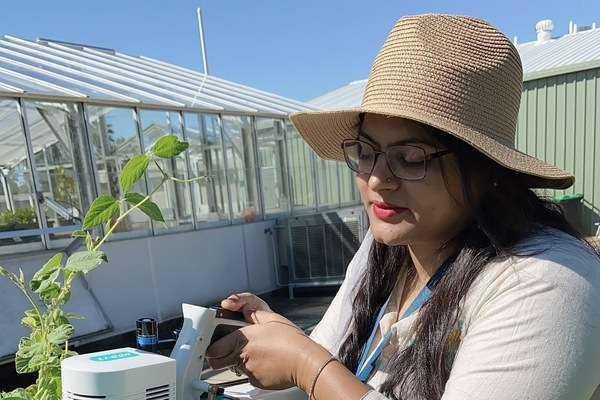 “
I chose CQU because of their high-quality research, accessible education, and the growing interest of industry partners in collaborative work to address the crop yield issues caused by multiple abiotic and biotic stresses. There is a great cultural mix at CQU with a very friendly environment.
Sobia Ikram
Doctor of Philosophy (PhD) | Pakistan
WHY CHOOSE CQU
A World of Support
We offer academic and financial support programs for HDR candidates.
World-class Research
22 areas ranked 'at', 'above', or 'well above' world standards.
Focus on Impact
We focus on research with direct impacts on our industries and communities.
Frequently Asked Questions
All prospective international candidates must apply via iStart. Applying for a Higher Degree by Research (HDR) at CQUniversity involves a two-stage process.
- The first stage is the Expression of Interest (EOI), also known as the Preliminary Proposal, which asks you to select your course and location, along with providing an abstract of your proposed research topic. Your abstract will be assessed to determine whether suitable supervisors are available.
- The second stage is the research proposal. Depending upon the outcome of your EOI and research abstract, you may be invited to submit a full proposal and application as a HDR candidate. The University reserves the right to refuse admission to any applicant.
The first stage of applying for a HDR at CQUniversity is the Expression of Interest where you will need to provide a brief overview of your research topic, typically presented as a research abstract. A research abstract is usually around 150-250 words that helps reviewers quickly understand your research focus, approach and intended contribution.
What should an effective EOI include?
A strong EOI should be clear, focused and specific. While requirements may vary across disciplines, most successful EOIs include the following four elements.
Research purpose
Introduce your research topic and explain why it matters. Consider what problem, issue or research question you will investigate; why the topic is important; what gap in existing knowledge your research addresses; and the main aims of your study.
Research methods
Briefly describe how you plan to conduct your research. Depending on your field, you may include research design or methodology; participants or sample group; data collection methods; data sources; and data analysis techniques.
Expected results or outcomes
Outline the key findings or outcomes you expect your research to achieve. You may include anticipated results; preliminary findings; key themes or areas of impact; and expected contributions to your field.
Conclusion and significance
Explain why your research is important and what contribution it will make. Consider how will your research address the identified problem; what new knowledge, insights or solutions it could provide; and how might it contribute to practice, policy, industry or future research.
Tips for developing your EOI
If you're unsure of where to start, focus on the core message of your research and your abstract around it. You can also explore CQU's research projects for inspiration and potential research directions.
Ask yourself:
- What interests you about this topic? Choose an area that genuinely interests you and aligns with your academic and career goals.
- What did you do? Summarise your research approach and methodology.
- What did you find? Identify the most important findings rather than listing every result.
- Why does it matter? Highlight the broader impact or significance of your study.
- What is the key takeaway? If readers remember one thing about your research, what should it be?
Here are some guidelines to help you prepare your proposal:
- What is your research project title? (max 30 words)
- Background to the proposed research and research question/s to be investigated. (max 500 words)
- What is the anticipated significance and/or impact of the proposed research? (max 200 words)
- What research methods will you use to undertake the proposed research? (max 300 words)
- What are the intended timelines to undertake the proposed research? (max 100 words)
- What resources, facilities, equipment, fieldwork will be required to undertake the proposed research? (max 200 words)
- What are the intended research outputs and contribution to research culture (max 300 words).
Please keep your proposal to no longer than 5 pages in length.
Higher degree by research applications may be submitted at any time of the year. The commencement date for candidature will be negotiated between the candidate and the University, and may be reliant on resources or supervisor availability.
Yes. Please note there are a number of CQU-funded scholarships available to new, international students undertaking higher degrees by research. Please check the International Scholarships page to learn more about which you are eligible for.
For all other HDR scholarships such as the RTP Stipend Scholarship, you must use the research scholarship online application form. Please check what is available on the Research Scholarships page or email [email protected] with any queries. These HDR scholarship rounds are only open twice a year.
If you don’t yet meet the admissions requirements for a higher degree by research, our Graduate Certificate in Research can provide an alternative pathway for you to reach your research goals.
First, try to resolve the issue by talking with your supervisor(s).
If that doesn’t work – or if you feel uncomfortable about doing that – then please contact the School of Graduate Research by emailing [email protected]. For confidential/particularly sensitive queries, students are welcome to contact the School’s Manager, Kath Milostic ([email protected]) or Dean Susan Kinnear ([email protected]).
Higher Degrees by Research
Explore groundbreaking research at CQU, a benchmark leader for how universities should engage with industry to deliver research with true impact. Check out our current research and explore the range of degrees below to help you make a difference and become a specialist in your field.




