
Seagrass flowers could hold the key to restoring Gladstone Harbour
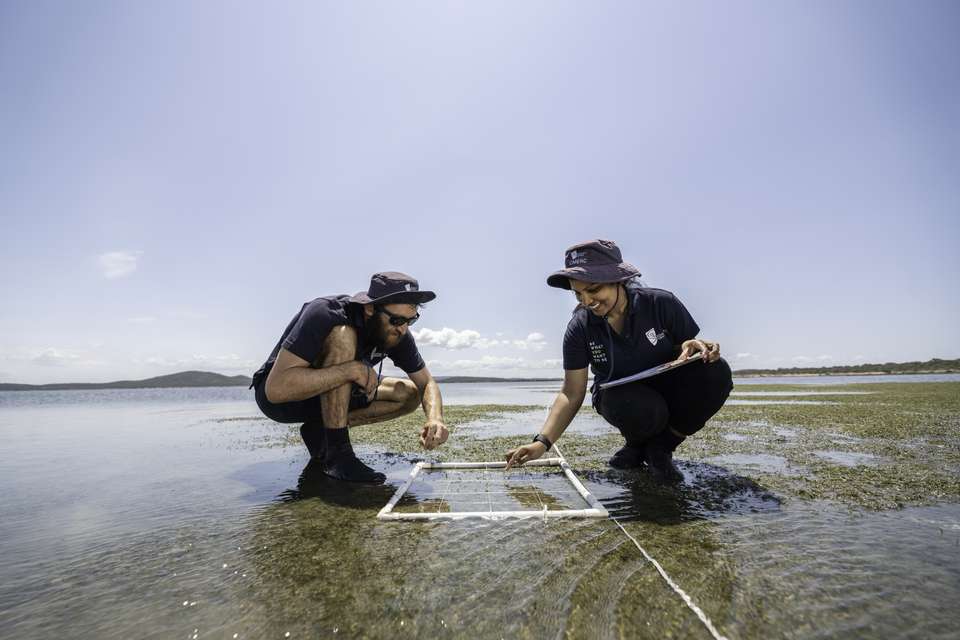
A small bucket of tiny flowers collected from the waters around Gladstone could become part of a much bigger effort to rebuild the region’s seagrass meadows.
CQUniversity’s Coastal Marine Ecosystems Research Centre (CMERC) is preparing for another season of seagrass flower collections, with community members invited to join researchers at Curtis Island on 26 September.
The flowers may be small, but the seeds they contain are central to CMERC’s research. Researchers will study the growing seeds to help develop more effective methods for restoring seagrass at scale.
CMERC Director Professor Emma Jackson said each collection season provides an important opportunity to build on the centre’s growing supply of seagrass seeds and knowledge.
“Every season gives us another opportunity to collect small amounts of material from healthy seagrass populations and learn more about how we can use those seeds in restoration,” Professor Jackson said.
“We are interested in what happens from flower to seed, from seed to seedling to plants, and ultimately how we can use that knowledge to establish healthy seagrass meadows again.”
The work forms part of CMERC’s SeaGrow Research Program, which is investigating practical ways to collect, store, grow and plant seagrass at scale.
Researchers are using the seeds in controlled experiments and restoration trials to look at innovations to get the seeds out on degraded meadows at scale.
The research is focused on one of the key challenges facing seagrass restoration, moving from small-scale planting experiments to approaches that can be used across much larger areas.
Professor Jackson said community participation was an important part of the research program.
“Our collection days bring together people who are interested in their local environment with researchers who are working to solve some very complex restoration challenges,” she said.
“You don't need to be a marine scientist to contribute. These events give people the chance to see the research happening firsthand and play a practical role in restoring these important habitats.”
The 26 September Curtis Island event will begin with an information session at the Curtis Island Community Hall, where participants will learn more about the research before heading into the field.
The timing of the collections is guided by the seagrass flowering season and provides researchers with access to flowers at the point when they can be collected for seed production.
For CMERC, the work represents another step towards a long-term vision for healthier and more resilient coastal ecosystems across the region.
“Restoring the resilience of seagrass meadows doesn't happen overnight,” Professor Jackson said.
“It takes research, patience and a good understanding of what makes a seagrass meadow successful in the first place.
“These flowers are one small but very important part of that bigger picture.”
Community members interested in participating in the 26 September seagrass flower collection at Curtis Island can register online. The event is free and includes the ferry to and from the island, an information session and involvement in the flower collection.
Further events will be held in October 2026.
The collection is part of CMERC’s ongoing SeaGrow research, supported through collaboration with research and industry partners including the Great Barrier Reef Foundation.