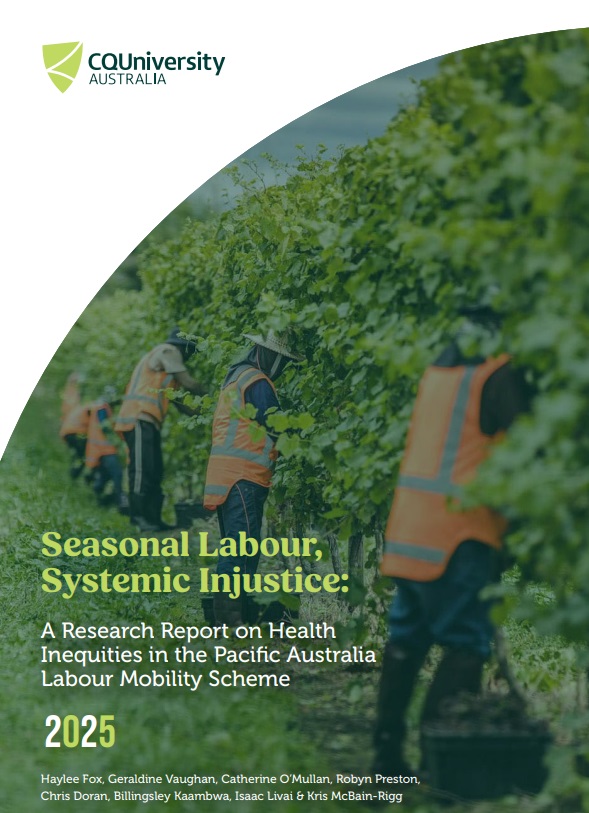
They work in tough conditions to put food on our tables, but new research shows tens of thousands of seasonal workers from Pacific Island countries and Timor Leste are unable to access basic health care in Australia.
The public health report heard from more than 60 Queensland-based workers on the Pacific Australia Labour Mobility (PALM) scheme, as well as employers, and healthcare workers.
The report found workers are excluded from Medicare and rely on costly and confusing private health insurance with major gaps in coverage, and no sick leave provisions.
Geographical distance from healthcare services also mean PALM workers face barriers to accessing timely and affordable care.
The report also found some instances of workers flying home to get free treatment in their own country, as flights were a fraction of the cost of treatment in Australia.
Lead author Dr Haylee Fox says that the PALM worker visa excludes them from Medicare and despite mandatory private health insurance, workers often face huge bills to seek medical assistance.
“These are people working in regional and remote areas with limited local services and no access to their own transport,” Dr Fox explained.
“Under the PALM scheme, workers are typically employed casually and are on minimum wages, whilst supporting families back at home, and paying Australian taxes that fund services like Medicare”
“Yet if they take time off due to illness or to see a doctor, they don’t get paid.”
“Many workers told us they delay or avoid seeking health care, conceal illnesses or injuries, and keep working while unwell because they’re afraid of losing their job, being deported, or being ‘blacklisted’ from returning to Australia,” Dr Fox explained.

The report makes 15 recommendations, including extending Medicare eligibility for all PALM workers, introducing paid sick leave entitlements under the PALM scheme, and funding after-hours and onsite care models, especially in regional and rural areas.
“Solutions are not only possible, but are being achieved where healthcare workers and conscientious employers tell us they ‘work around the system’ to do what they can to get health services for PALM workers,” Dr Fox said.
“Meaningful reform is essential if Australia is serious about protecting the health and human rights of the people who sustain key industries.”
Since 2022, the CQUniversity-led research group has been uncovering how systemic and structural barriers prevent PALM workers from accessing essential healthcare, and providing evidence and advocacy for action to improve experiences for Pacific communities supporting Australia’s regional industries.
The report co-authors are CQUniversity researchers Dr Geraldine Vaughan, Associate Professor Catherine O’Mullan, Dr Robyn Preston, Professor Chris Doran, and Isaac Livai, with Dr Kris McBain-Rigg from James Cook University and Assoc Prof Billingsley Kaambwa from Flinders University.
The group’s work is funded by the Commonwealth Government Department of Health, Disability and Ageing.
More than 31,000 PALM workers are currently in Australia, with 91 per cent employed across agriculture and meat processing industries and 38 per cent in Queensland.

CQUniversity Australia is a trading name of Central Queensland University
ABN: 39 181 103 288
RTO Code: 40939
CRICOS: 00219C
TEQSA: PRV12073