Aquatic Ecology and Ecotoxicology
Aquatic Ecology and Ecotoxicology research at CQUniversity focuses on improving monitoring, assessment, management and reporting frameworks, to minimise the impacts of land use on freshwater, estuarine and inshore marine environments. Our researchers include biologists, ecologists, environmental chemists and ecotoxicologists. We conduct interdisciplinary research, frequently collaborating with agricultural scientists, economists and social scientists, and have an ethic of promoting stakeholder engagement, delivering innovative solutions to managing rivers and estuaries in a changing environment.
Active researchers in the Aquatic Ecology and Ecotoxicology group include:
- Dr Nicole Flint
- Dr Amie Anastasi
- Miss Alison Craig
- Dr Leo Duivenvoorden
- Associate Professor Larelle Fabbro
- Mr Wayne Houston
- Miss Catherine Jones
- Mr Adam Rose
- Dr Leigh Stitz
Current HDR students in the Aquatic Ecology and Ecotoxicology group include:
- Sabiha Sultana Marine
- Adam Rose
- Anna Skillington
- Catherine Jones
- Debbie Dolby
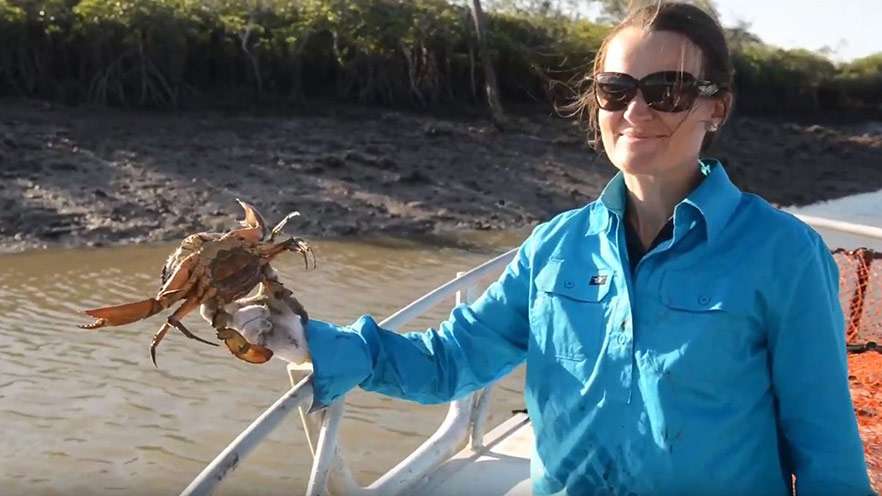
Developing a Mud Crab Indicator for the Gladstone Harbour Report Card
Investigators: Dr Nicole Flint, Dr Emma Jackson, Dr Amie Anastasi, Dr Evan Chua, Dr Jeremy De Valck
Funded by: Gladstone Healthy Harbour Partnership (GHHP)
Mud crabs (Scylla spp.) are key fisheries products in Africa, Asia, Australia and the South Pacific. In Queensland, the total annual catch of mud crabs was approximately 1,000 tonnes worth AUD18.7 million in 2015. Green mud crabs (S. serrata) are recreationally and commercially important in Gladstone Harbour and are an iconic seafood item, with cultural value to some Indigenous Australian peoples. As a result of their commercial importance to the fishing and aquaculture industries, the biology, ecology and biochemistry of mud crabs is relatively well known. Mud crabs have potential as biological indicators as they are sedentary, easily identifiable, abundant, long-lived, resistant to handling stress and tolerant to environmental variations.
Study aims
The primary aim of this study was to develop a mud crab indicator, with appropriate baselines and scoring systems for use in a waterway health report card.
Research Report: Flint, N., Anastasi, A., De Valck, J., Chua, E., Rose, A., and Jackson, E.L. (2017) Developing mud crab indicators for the Gladstone Harbour Report Card: Project ISP015-2017. Report to the Gladstone Healthy Harbour Partnership. CQUniversity Australia, Queensland. Available at: dims.ghhp.org.au/repo
Developing Fish Health Indicators for the Gladstone Harbour Report Card
Investigators: Dr Nicole Flint, Dr Emma Jackson, Dr Amie Anastasi, Associate Professor Andrew Irving, Dr Jeremy De Valck
Funded by: Fisheries Research and Development Corporation (FRDC) and the Gladstone Healthy Harbour Partnership (GHHP)
Fish are key biological indicators of environmental contamination, as they are continuously exposed, ubiquitous in aquatic ecosystems, and play an important ecological role. Fish health indicators, such as morphometry, gross pathology, histopathology, fish parasite load and diversity, or chromosomal mutations, provide information on the cumulative impacts of various human activities on aquatic environments.
Study aims
- To review and identify suitable methods to monitor fish health in Gladstone Harbour.
- To develop and implement a data collection approach to monitor fish health in Gladstone Harbour that is both cost-effective and suitable for a fish health indicator.
- To evaluate the potential to adapt and transfer the methods and indicators developed to monitor fish health in other estuaries and ports in northern Australia.
- To develop baselines and scoring systems for the fish health indicator(s) and apply them to the Gladstone Harbour Report Card.
Offstream Watering Points to Reduce Cattle Impacts on Riparian Zones
Investigators: Mrs Julie-Ann Malan, Dr Nicole Flint, Professor David Swain, Dr Emma Jackson, Associate Professor Andrew Irving
Funded by: Fitzroy Basin Association and CQUniversity Australia
Land clearing and agricultural practices have contributed greatly to water quality concerns for freshwater catchments and the Great Barrier Reef lagoon. Best management practices for grazing activities, such as providing off-stream watering points (OSWP), have been recommended to improve water quality. It is commonly assumed that by installing an OSWP, the number of cattle, or the frequency or duration of visits by cattle to the riverbank will be reduced. However, there is a limited understanding and a lack of quantitative data linking in-stream water quality to the installation of OSWPs. Environmental and social factors may influence how cattle use OSWPs and it is currently unclear whether such factors can be manipulated to reduce visitations to streams. This research project will seek to evaluate the effectiveness of installed OSWPs in the Fitzroy Basin, determine how cattle use OSWPs, and quantitatively link these outcomes to in-stream water quality and riparian condition, providing recommendations for graziers and natural resource management groups.
Study aims
- Review and evaluate the strategic placement of OSWPs and how cattle use them
- Provide recommendations to assist in optimising the placement of OSWPs to improve the riparian condition and in-stream water quality.
- Provide new data on best practice grazing land management for natural resource management groups and graziers.
Journal Article: Malan, J-A., Flint, N., Jackson, E.L., Irving, A.D., and Swain, D.L. (2018) Offstream watering points for cattle: Protecting riparian ecosystems and improving water quality? Agriculture, Ecosystems and Environment256: 144-152.
Development of a Toolbox for Fish Health Assessment in Aquatic Ecosystems Associated with Coal Industries
Investigators: Dr Nicole Flint, Dr Evan Chua, Dr Scott Wilson, Dr Sue Vink
Funded by: Australian Coal Association Research Program (ACARP)
Biological indicators provide a comprehensive assessment of ecosystem health, capture cumulative impacts and represent key assets that the community can identify with. Fish are the dominant organisms in terms of biomass, feeding ecology and significance to humans, in aquatic ecosystems. In comparison to fish from the Northern Hemisphere, there is limited information on the environmental tolerances of tropical Australian freshwater fish species, and most current information is circumstantial, derived through field observations of water quality and the fish species present at the time of sampling. Whilst the tolerance of various Australian freshwater fish species to commonly monitored stressors such as electrical conductivity, turbidity, nutrients and low dissolved oxygen concentrations have been documented in this way, there is even less available data on the tolerance of freshwater species to environmental toxicants such as pesticides, metals and hydrocarbons. There is, however, a large and increasing body of literature addressing these impacts for freshwater fishes globally. There is a need for practical indicators of fish health that are demonstrably applicable to monitoring in coal mining regions of the Fitzroy Basin, to improve aquatic ecosystem health assessments and inform regional water management.
Study aims
This study aimed to develop practical fish indicators suitable for deployment in remote rural monitoring programs and for reporting on waterway health, by:
- Investigating and testing existing indicators of fish assemblage health in the Fitzroy Basin;
- Designing new indicators relevant to mine-associated waters of the Fitzroy Basin; and
- Developing a rapid fish health assessment toolbox applicable to the Fitzroy Basin.
Research Report: Flint, N., Chua, E., Wilson, S., and Vink. S. (2017). Development of a toolbox for fish health assessment in aquatic ecosystems associated with coal industries. Australian Coal Association Research Program Project C24029. CQUniversity Australia, Queensland. acarp.com.au/abstracts
Journal Article: Chua, E.M., Flint, N., Wilson, S.P., Vink, S. (2018) Potential for biomonitoring metals and metalloids using fish condition and tissue analysis in an agricultural and coal mining region. Chemosphere 202, 598-608.
- CQUni Researchers Take Part in Annual Fitzroy Catchment Community Event
CQUniversity water researchers Dr Nicole Flint, Dr Leigh Stitz and PhD candidate Julie-Ann Malan took part in the annual catchment community event to increase awareness of the pest fish tilapia and to take part in the National Waterbug Blitz, hosted by the Fitzroy Partnership for River Health. - Mud Crabs Sandwiched into Environmental Monitoring Toolkit
The Gladstone Healthy Harbour Partnership has been able to add a mud crab indicator to its annual report card, thanks to new research by CQUniversity. - Aussie Ghostbusters Helping to Solve a 136-year Microscopic Mystery
Back in 1882, a Norwegian traveller called Mr Lumholtz trudged through a lagoon in Queensland. A few years later, he took some interesting mud samples back to a scientist called Sars in Oslo. - Boosting Data from Biological Indicators a 'High Priority' for Fitzroy Basin Report Card
CQUniversity is a long-standing member of the Fitzroy Partnership for River Health which recently released its 2015-16 Report Card. This sixth report for the Fitzroy Basin has scored the river condition a grade of B (Good) for the third consecutive year. - Riverbanks could benefit from Optimal Placement of Cattle Watering Points
The condition of riverbanks and river water quality could benefit from optimal placement of watering points used by cattle. - Why Scientists are Keen to Avoid being Baffled about Baffle Creek
Located south of Gladstone, Baffle Creek is the only remaining ‘near-pristine’ river to empty into the Southern Great Barrier Reef. Its other ecological importance is in bolstering scarce knowledge available about the water quality dynamics of dam-free sub-tropical streams.